Originally published on Patch.com, December 14, 2009.
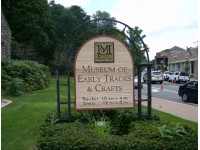
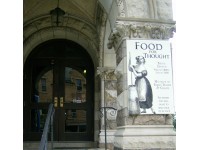

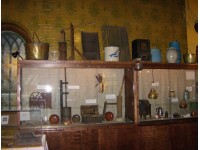
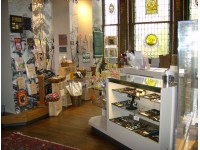
The Museum of Early Trades and Crafts sits meshed between history and technology, amidst modern roads and shops in the center of town. With its cathedral-like vaulted ceilings shaped by glossy bricks in a relaxed shade of green and colorful stained-glass windows, the entire building is almost Dickens-like, complete with a Christmas wreath hanging on the overhead railing.
The structure, built by D. Willis James over 100 years ago, was originally intended as Madison’s first free public library. However, when the library outgrew the limited space in 1969, Edgar and Agnes Land lobbied to turn the building into a museum where they could showcase their extensive private collection.
“They were avid collectors of objects of early trade: they stored these items in their home and invited school groups and children to visit,” said Vivian James, director at the museum.
After extensive remodeling in 1997, the museum has been restored to its original form. Even the old bookshelves are utilized as exhibit cases.
This museum showcases items used by typical men, women and children from around the early 1800s. One permanent exhibit shows items that members of a typical American family used to survive. Most of the wooden items are bleached from use.
“A lot of historic homes are about some really wealthy guy, but we are talking more about the ordinary cycle the average American had to do to survive,” said James.
The current exhibit is entitled “Food for Thought,” and has been open since February of this year. It covers topics from cooking methods of the early settlers, to the typical diet of early Americans, to objects used to make cooking a little easier.
However, some items might not have been worth the effort compared to modern technology. For example, there is a food chopper that required a woman to lean her entire body weight against a giant block of wood that was placed strategically inside a barrel. The woman’s weight and strength was used to mash such items as apples.
“We call that one the worst Cuisinart ever,” James said.
New Jersey schools have made trips to this museum a part of the core curriculum. The staff at the museum have arranged different activities for students from kindergarten to 12th grade.
The younger children are entertained by the mascot, Widget the Beaver. This fluffy hand puppet brings out his other furry friends to help tell stories. Children also have the opportunity to do crafts and play with era toys while playing dress-up.
The older students are offered a tour and crafts based on age level and relevance to the topic. The museum also offers creative journal writing for students preparing for standardized tests.
“We think it’s important for schoolchildren to have an understanding of this area and how people lived,” said Tom Judd, chairman of the operations committee. “People in the past in New Jersey have influenced our lifestyles today; we’re really all building on the groundwork that these early people laid down for us.”
There are activities for adults. Recently there was a jewelry-making workshop, and a colonial cooking contest will be held on Jan. 10.
The staff provides programs for the developmentally disabled where they can experience extensive multiple-session art programs and write journals based on their experiences.
The museum also organized this past summer’s outdoor concert series, in association with the town of Madison, Provident Bank, Blueridge Mountain, and the Star Ledger. This event closed the street by the museum to create a venue every other Friday from mid-July to mid-October.
“This event was to help (bring) foot-traffic to the downtown area and foster a central community gathering spot,” James said. “It’s important for people to feel like this is their museum; this was their library so I want people to feel connected.”
James has always been interested in early crafts and trades and has a degree in metal-smithing. She said that she wants people to have a strong understanding and connection with the past.
She spoke of an instance where a grandmother and her grandson were touring the museum, and the grandmother spotted the cookie presses. The grandmother gasped and said that she hadn’t seen them in years–that her own grandmother had this kind of press.
“It was a trans-generational moment: the grandson was learning what it was like for his grandma as a little girl his age,” James said. “I want people to come away with a closer, more personal connection to the past.”
The “Food for Thought” exhibit will remain open until Jan. 15. The museum will reopen Feb. 2 with a new exhibit titled “Lenape Tools and Daily Living.”
The museum hours are Tuesday through Saturday from 10 a.m. to 4 p.m. and Sunday from noon until 5 p.m. The museum is not open on Mondays. Visit the museum’s Web site at: http://metc.org/.
Visitors interested in becoming members can register online at: http://metc.org/membership.htm, or fill out a membership registration form at the museum. Members receive discounts and free admission to the museum.
 Rayna J Lewis
Leave a comment